 EII Analytics Suite, Tool Catalog
When I joined BlackRock's Equity Index Investing division in 2019, there was no internal design capability. Product and engineering ran the roadmap. Design decisions were made inside sprints, in Sketch files owned by an external agency with no visibility into user behaviour or strategic intent. Multiple products across the suite had no shared visual language, no design system, and no designer embedded in any team.
The brief was double-sided: build the design function, hire, embed, and establish practice, while simultaneously delivering design across an actively shipping product portfolio. Neither track could wait for the other.
Track 1: Building the Design Organisation. The first move was bringing core design ownership internal. One designer (me) across all active products. The goal wasn't to do everything, it was to establish design as a first-class discipline inside EII, not a service bought in by the sprint. As product scope expanded, the structure scaled: each product squad got an embedded design unit with a design lead, a UX researcher, and a visual design specialist. Quarterly design reviews brought product leadership and executive management into the design process as working sessions, not sign-off checkpoints, creating strategic alignment across the suite and giving design the visibility to make system-level decisions stick.
The first shared infrastructure was deliberate rather than ambitious: a documented button system and grid framework that could propagate across products. Not a full design system on day one, a foundation that made the next layer of consistency achievable without rework. Weekly cross-product design meetings aligned interaction patterns, surfaced shared components, and prevented each squad from solving the same problem in isolation. The result: EII went from no design to a mature, embedded, multi-squad function across four years, with a shared system, a research practice, and executive visibility.
Track 2: EII Product Design. The EII Analytics Suite serves institutional investors across five distinct use cases: research and portfolio construction, market monitoring, index strategy, risk analysis, and factor analysis. Before products could feel like a suite, they needed a shared identity. EIIRA (Equity Index Investing Research & Analytics) became the brand framework, a custom geometric letterform identity designed to sit inside BlackRock's institutional context without defaulting to the parent brand's generic UI language.
Six products followed. Fund Navigator gave analysts a chip-based screening system with persistent filter logic, watchlists, and alert configurations for Tick, Competitor, and Block signal types. Market Surveillance became the operational nerve centre for ETF secondary market monitoring, with an alert pane that grouped signals by type for analysts working at trading speed. Index Intelligence served index strategists anticipating rebalance events, with trade strategy recommendations attached directly to the agenda item rather than siloed in a separate workflow. Total Portfolio Workbench held risk, factor, and ESG frameworks simultaneously, anchored by a shared portfolio header. Factor Workbench made comparative portfolio analysis fast through side-by-side delta presentation. Liquid Beta gave institutional investors a portfolio construction tool for iShares ETF substitution, leading with the decision they were actually making: which substitution maximises exposure match while minimising drag.
The harder thing to measure, but the thing that makes the product design work sustainable: institutional investors who use one product in the suite don't have to relearn the system to use another. The patterns transfer. The alert conventions are familiar. The filter logic behaves the same way across contexts. That's not an accident. It's the result of building the design function and the design system in parallel, deliberately, from the start.
EII Analytics Suite, Tool Catalog
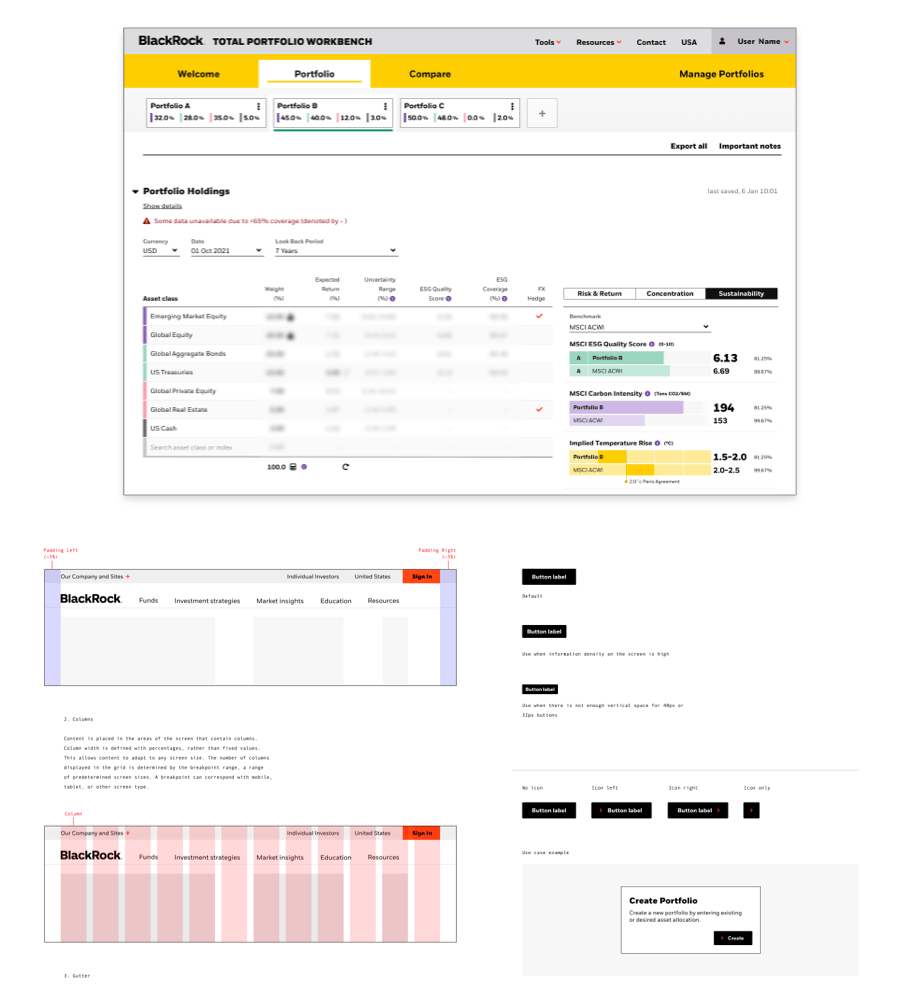
 Total Portfolio Workbench
 Index Intelligence, Rebalance Events
The transformation of BlackRock's EII suite established design as a foundational strategic asset. By 2024, every product in the suite operated on unified design standards, reducing time-to-market by 40% and support burden by over 30%. The design system became the reference architecture across the broader BlackRock digital portfolio, influencing design practice across multiple business units. Most importantly, institutional investors reported higher confidence in the platforms and faster completion of complex portfolio analysis tasks, translating design maturity directly into business outcomes for clients managing trillions in assets.
"Great enterprise design isn't about making things beautiful, it's about making complex systems so clear and trustworthy that decisions become effortless."