Kuehne+Nagel · Amsterdam, NL · 2024–Present

Road Carrier
Solution
Design

Role Principal Product Designer / Service Design Lead
Duration Oct 2024–Present
Scope Enterprise UX, Logistics, AI Products
B2B SaaS Logistics Mobile
06
1.0
0.55
22.0
12.0
0.35
0.12
0.055
0.5
0.008
drag to reposition · double-click to reset
20K+
Carriers on the platform
6
Features designed & shipped
3
Platforms (desktop/mobile/tablet)
100+
Countries of operation

The Challenge

Kuehne+Nagel is one of the world's largest logistics companies, operating across sea, air, road, and contract logistics in more than 100 countries. Their Road Carrier Solution (RCS) is the digital platform that manages communication and data exchange between K+N, their carrier partners, and the truck drivers executing shipments. Used by more than 20,000 carriers across Europe, Africa, and the Middle East, it's the operational backbone for road freight: trip instructions, real-time GPS tracking, driver communication, proof of delivery, and status updates, all in one place.

I joined the Road Carrier Innovation Unit as Lead Designer with a brief to close the gap between UX and front-end engineering, and to raise design quality across a platform that had grown faster than its design foundation. When I joined, design existed as a step that happened before development, not alongside it. UX decisions were getting made inside sprints without design input.

The fix was structural. I joined the sprint process directly: picking up Jira tickets, building concept prototypes tied to specific story requirements, and producing UX documentation in a consistent format that engineering could reference without a separate briefing. Every feature track (SCD, EV Routes, Parking, Carrier Profile) has the same document structure: status, goals, HMW, requirements, prototype links, dev-ready sign-off, and open issues. That consistency became the shared language between design and engineering.

I also established a design backlog, a running queue of UX debt, IA improvements, and visual inconsistencies to address outside the feature release cycle. Combined with regular alignment sessions with business stakeholders and management, this gave the team a visible design roadmap and gave leadership the strategic confidence to invest in UX as a long-term capability.

The engagement runs across two parallel tracks: embedding design into the engineering team's way of working, and delivering UX and UI across a portfolio of features and platform improvements. This is a long-form engagement. The goal isn't to ship and leave, it's to permanently change how the team approaches design. Every design decision also functions as a precedent. The style guide, the sprint integration, the consistent documentation format: none of these are outputs in themselves. They're the conditions that make the feature work sustainable as the product scales to more carriers, more regions, and more complex operational requirements.

Six Design Tracks

01
App-Wide UI Refresh & Style Guide
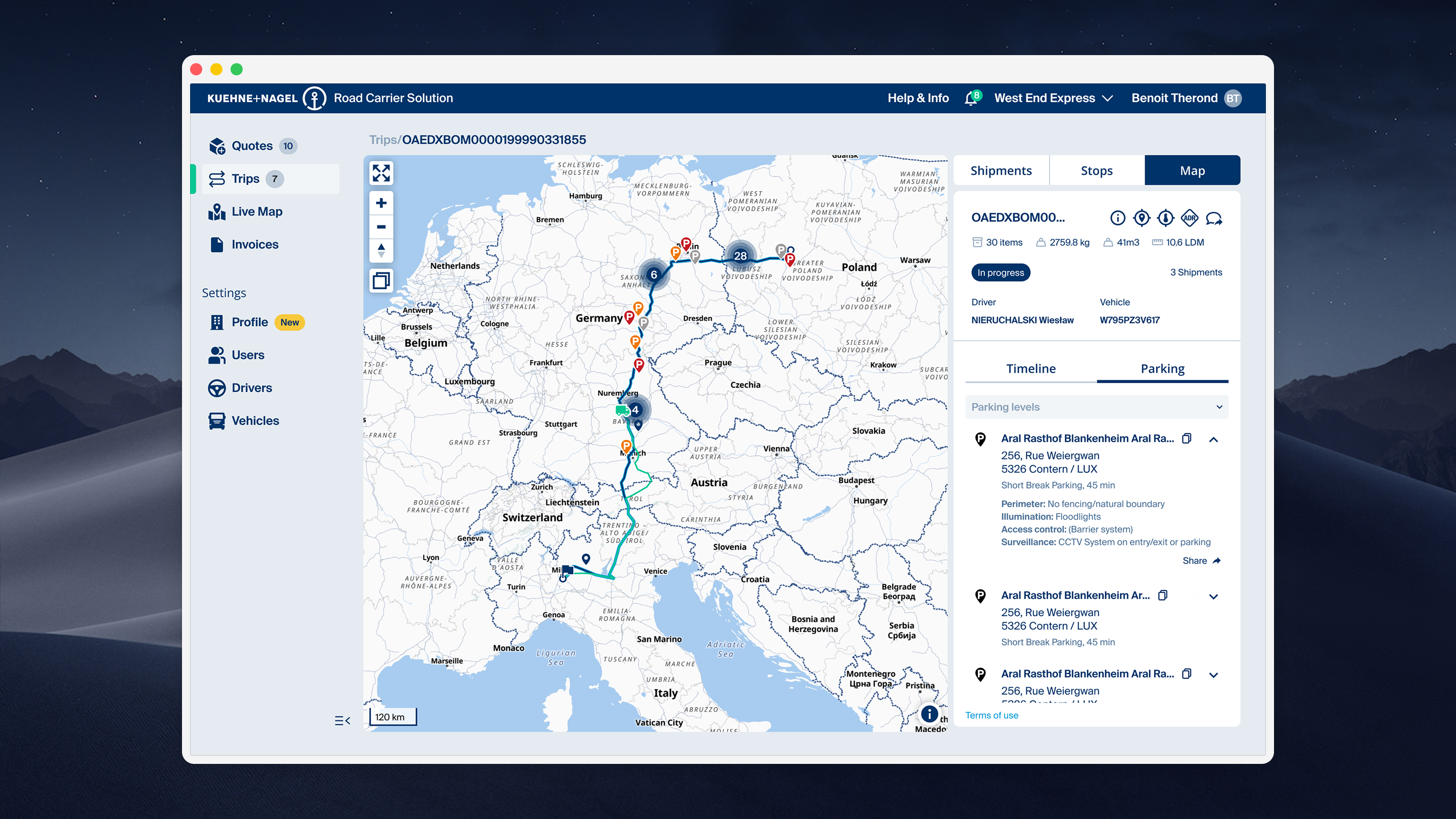
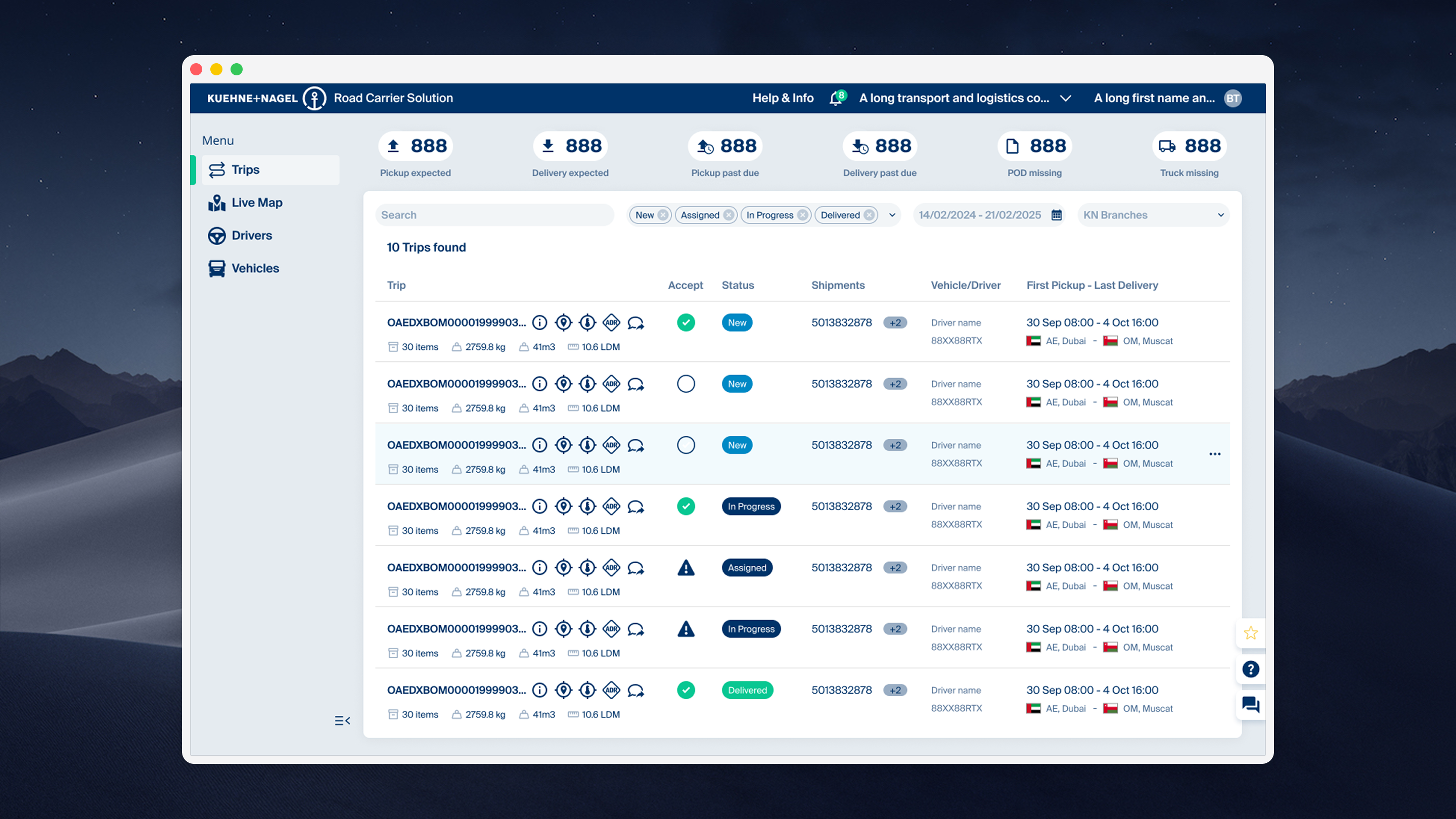
Aligned the RCS interface with KN brand standards, cleaned up typographic hierarchy, and migrated the map to a custom style created for RCS. Formalised a style guide in Figma documenting type styles, colour system, and icon standards, the infrastructure for everything that followed.
02
WhatsApp Integration
Designed the end-to-end carrier flow for trip communication via WhatsApp, the channel drivers already live in. A four-step carrier flow in RCS, and an 11-step WhatsApp conversation chain that closes the trip from pick-up through proof of delivery without a single login.
03
Parking & Route Optimization
Brought vetted parking selection directly into the RCS trip view. Cluster visualisation with security level breakdown (High / Medium / Basic / KN / Short Break / Negative). Filter, detail panel, and a one-time ToR gate handled as a saved preference to avoid repeat friction.
04
EV & Sustainable Route Planning
Powered by Bosch, this feature communicates EV feasibility through three trip states and a colour-coded polyline (green/orange/red for battery state). Charging stop markers, configurable routing, and a trip summary block, giving carriers a realistic picture of any lane's EV viability.
05
Secure & Tracked Delivery (SCD)
Chain-of-custody design for high-value shipments across mobile and tablet. Stop tiles with three states (Ready, Active, Completed) plus a Customs tile type. Status updates physically gated to arrival context. Full Figma prototype covering the happy path with video walkthrough.
06
Carrier Profile
Gave carriers a structured way to share fleet capabilities, preferred lanes, specialisations, and operational contacts with K+N. Tabbed across Company, Contact, Equipment, and Routes & Regions. Pre-filled from existing K+N data. Modal-based editing per field group, with a GDPR consent gate on the Contact tab.

KN-OPS, a new AI-augmented operations product

Alongside the carrier platform redesign, I designed KN-OPS from zero to one: a new AI-augmented operations product built to optimize sales conversion and operational workflows through email and data synthesis with reasoning capabilities.

The method itself was the differentiator. I used AI to move from raw user and stakeholder research to working prototypes in days, synthesizing inputs, generating interaction concepts, and producing testable designs at speed. Those prototypes went straight to business stakeholders, iterating on real feedback to validate conversion workflows and decision logic before any engineering commitment. The result: complex operational ecosystems simplified into clear decision workflows, with faster decision cycles in sales and operations.

Four-Phase Transformation

01
Maturity Assessment
Conducted comprehensive baseline assessment of design maturity across global organisation. Interviewed stakeholders across product, engineering, operations, and leadership. Identified critical gaps: no design system, no governance, fragmented language. Built business case for systematic design investment.
02
Design Operations Setup
Established DesignOps function from scratch. Selected tools for distributed teams. Created design asset management, component versioning, and cross-team workflows. Built governance balancing consistency with shipping velocity. Established design metrics and ROI measurement.
03
Team Building & Hiring
Recruited design leadership and practitioners into company where design was previously invisible. Established hiring criteria and onboarding programmes. Built mentorship structure for distributed teams. Created sustainable team growth pathway across locations.
04
Governance & Culture
Established design governance model balancing autonomy with consistency. Created design review boards with clear escalation paths. Built design community through retrospectives, sharing sessions, and cross-team initiatives. Fostered culture of design excellence in operational environment.

Role & Responsibilities

1
Design Maturity Assessment, Conducted comprehensive baseline assessment of design maturity across 77,000-person organisation. Interviewed stakeholders across product, engineering, operations, and leadership. Identified gaps: no design system, no design governance, no shared tools, fragmented design language. Built business case for systematic design investment across global operations.
2
DesignOps Establishment, Built design operations infrastructure from zero. Selected tools appropriate to distributed teams. Established component versioning, design asset libraries, and cross-team communication workflows. Created design metrics tracking adoption, time-to-market, and ROI. Built processes that scaled without creating bureaucratic friction preventing shipping.
3
Team Building & Hiring, Recruited design leadership and practitioners into 160-year-old company where design was previously invisible. Built compelling recruitment narrative. Established hiring criteria identifying designers who could thrive in engineering culture while advancing design maturity. Created onboarding programme and mentorship structure for distributed teams.
4
Process Design, Designed governance model balancing consistency with autonomy. Created design review boards with clear escalation paths. Established contribution model allowing product teams to propose new patterns. Designed rituals: weekly design critiques, quarterly planning cycles, design retrospectives. Built community enabling distributed designers to learn from each other.
5
Executive Alignment, Secured executive sponsorship and multi-year budget commitment for design maturity investment. Demonstrated business case: improved customer experience reducing support burden, faster product delivery, stronger employer brand. Built quarterly reporting cycles showing progress against Design Maturity Model. Maintained momentum through organisational transitions.
Organisational Scope
Global logistics company with 77,000+ employees. Multi-regional product teams. Customer-facing and internal tools spanning dozens of platforms.
Maturity Journey
Baseline: Near-zero design maturity. Target: Level 2-3 (Structured/Integrated) within 18 months. Strategy: Four-level evolution model with clear milestones.
Impact
Design recognised as strategic capability. 50+ designers hired and onboarded. Design embedded in 20+ product teams. Executive alignment secured for 3-year investment.
Selected Screens
Road Carrier Solution · trip view with route map
EV route planning · charging stops & battery states

Outcomes & Impact

The design maturity transformation is ongoing, but already demonstrating significant impact across the global logistics platform. Customer-facing redesigns have reduced support ticket volume by 18% while improving Net Promoter Score across regions. Employee experience platform redesigns have improved self-service adoption for HR and operations workflows by over 40%. The Design Maturity Model provides a clear evolution pathway for a 77,000-person organisation, with progress benchmarked quarterly against strategic objectives. Kuehne+Nagel's design capability is evolving from invisible infrastructure to visible competitive advantage, improving customer experiences, reducing operational burden, and attracting design talent to one of Europe's largest logistics organisations. The foundation laid today will compound over years as design becomes embedded in how Kuehne+Nagel makes decisions.

77,000+
Employees across 1,300+ locations in 100+ countries now operating within evolving design governance framework, improving consistency and reducing duplicated effort.
Design maturity organisation established from scratch
4-level
Design Maturity Model established, from Aware to Strategic, providing clear waypoints for organisational evolution and measurable progress against design investment.
Level maturity model guiding evolution and investment decisions
Hiring
Onboarded design leadership and practitioners into 160-year-old company where design was previously invisible. Built recruitment pipelines, onboarding, and culture.
Designers hired and onboarded into organisation
$B+ value
Global logistics platform operationalised with improved user experience, better employee efficiency, faster customer onboarding, reduced support burden across operations.
Design discipline embedded across enterprise as continuous practice
"Design maturity isn't a destination, it's a discipline. You don't arrive; you iterate."
Previous Project
Ultimate Ears iOS & Android App
Next Project
MindSync AI Brand Intelligence