GenLab Studios · San Francisco / Remote · 2025–Present

Threat
Intelligence
Platform

Role Product Design Lead
Duration Feb 2025–Present
Scope Cybersecurity, B2B SaaS, AI-Native Design
Cybersecurity AI-Native B2B SaaS
08
1.0
0.55
22.0
12.0
0.35
0.12
0.055
0.5
0.008
drag to reposition · double-click to reset
10
Design iterations (V1→V10)
5
User personas interviewed
4 weeks
Concept to RSA demo
AI-native
Full build process

The Challenge

TLM42 is a threat intelligence platform that treats investigation as a collaborative act between analyst and AI. Built for Security Operations Centres (SOCs) and CISOs, it gives analysts an adaptive investigation workspace: load evidence, an IP address, a file hash, a PDF report, a screenshot, an alert, and the platform analyses it, enriches it with related IOCs and threat actors, and surfaces AI reasoning that can be traced, edited, and shared. Every output is portable: reports, actor profiles, and IOC collections export in the formats the recipient actually uses (PDF, .docx, STIX JSON) without requiring a login or a special tool on the other end.

GenLab-Studios is a design and product studio built around a single premise: that the gap between design and engineering has closed enough to collapse them into one workflow. TLM42 is our first product. The question we started with wasn't "what should a threat intelligence platform look like?" It was "what does a design process look like when the gap between concept and working prototype is measured in hours?"

We ran structured async audio interviews with five users across the distinct roles that converge on a threat intelligence platform: a TI Analyst focused on IOC triage, a TI Analyst specialising in threat actor attribution, a TI Analyst covering threat landscapes, an IR Analyst handling active incident correlation, and an IS Manager responsible for board reporting. Five principles came out of the interviews: evidence first (not prompts), show your work always (AI reasoning must be traceable), enrich in the background (never a modal), every output must be portable, and the interface follows context not role.

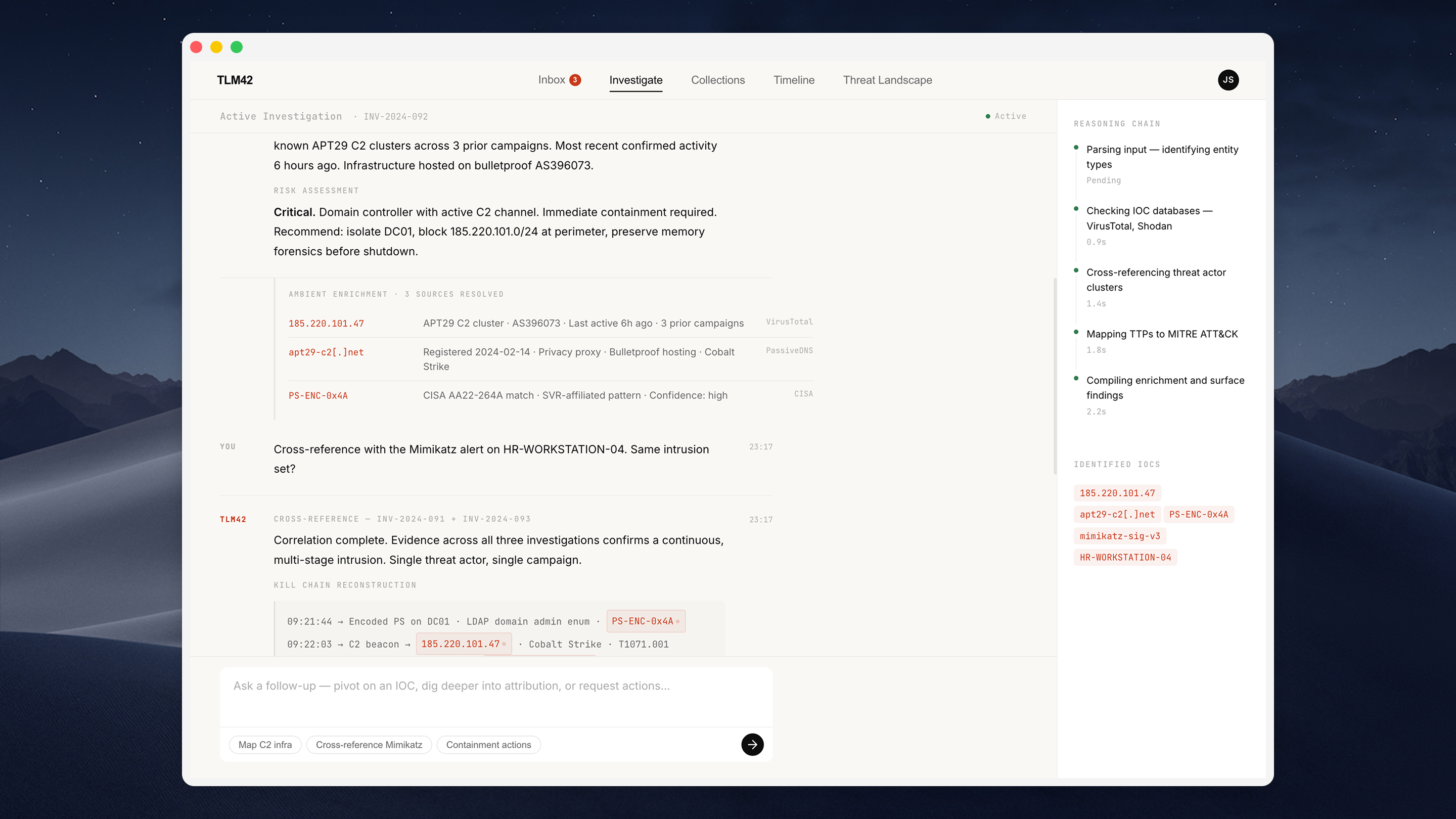
The single most important design decision in TLM42 is that the AI's reasoning is always visible alongside its output, not buried, not available on request, always on. This came directly from research. Every analyst we spoke to had been burned by black-box AI output: a clean answer with no provenance, no way to check whether the underlying sources were reliable, no way to share the reasoning chain with a colleague who needed to act on it. Hiding the thinking doesn't make the interface cleaner. It makes the tool unusable for serious work.

TLM42 was never designed in static screens. Every iteration was a live, interactive prototype, tested in the browser. The AI-native toolchain, Pencil.dev for wireframing, Lovable for live prototype generation, Figma Make and Stitch for design-to-code, Claude Code for custom interaction logic, Linear and Git for version control, replaced traditional handoff with a live navigable HTML prototype that the full team could use, test, and demonstrate. Ten versions. The current state: a minimal interface that disappears behind the work. The canvas, the reasoning, the evidence. Those are the product. The chrome is not.

Research to Demo in Four Weeks

01
User Research
Structured async audio interviews with five users across all major roles on a threat intelligence platform: IOC triage analyst, threat actor attribution analyst, threat landscape analyst, IR analyst, and IS manager. Each interview surfaced role-specific workflows, failure modes with existing tools, and the non-negotiables for a tool they'd actually use.
02
Five Design Principles
Evidence first, not prompts. Show your work, always. Enrich in the background. Every output must be portable. Interface follows context, not role. These five principles, derived directly from research, governed every subsequent design decision from IA through to V10.
03
IA & Navigation Design
Four functional areas: Investigate (evidence canvas and reasoning layer), Library (threat actors, IOC collections, threat landscapes), Reports (completed and shareable intelligence outputs), and Templates (pre-built structured outputs). A single adaptive workspace serves all of them, context creates flow, role gates create silos.
04
AI-Native Build Process
Pencil.dev for wireframing. Lovable for live prototype generation from natural language. Figma Make and Stitch for design-to-code. Claude Code for custom interaction logic. Linear and Git for version control. The result: a live, navigable HTML prototype with real navigation and real AI output patterns, not a simulated click-through.
05
Ten Iterations
V1 established the dark tactical foundation. V4-V6 introduced inbox patterns for alert volume, useful, but too inbox-like for investigation. V7 tested light mode, cleaner for dense data, wrong tone for security. V9 pushed AI reasoning prominence. V10: minimal interface that disappears behind the work.
06
Investigation Workspace
Canvas shows evidence, output, and reasoning as a single surface. AI reasoning always visible alongside output, never hidden behind a clean summary. Input mode always explicit: 'Analyse this' vs 'Use as context' is a first-class reversible choice at every step. Intelligence built in TLM42 exports in the format the recipient actually uses.

My Role

1 User Research, Designed and conducted five structured async audio interviews across distinct SOC and security management roles. Synthesised findings into five non-negotiable design principles that governed every subsequent decision in the product.
2 Information Architecture, Designed the single adaptive workspace model with four navigation areas (Investigate, Library, Reports, Templates). Established the context-driven UX logic: the interface responds to what you load, not who you are.
3 AI-Native Design Process, Led an entirely AI-native design-to-build workflow using Pencil.dev, Lovable, Figma Make, Stitch, and Claude Code. Every iteration was a live, navigable prototype, replacing static handoff with a testable, demonstrable product at every stage.
4 Investigation Workspace Design, Designed the core UX paradigm: evidence, output, and AI reasoning visible simultaneously in a single canvas surface. Established the always-on reasoning layer as a non-negotiable trust mechanism based directly on research findings.
5 Version Iteration, Led ten design iterations from V1 (dark tactical foundation) through V10 (minimal, evidence-forward interface). Each version was a deliberate direction change, not a refinement, testing inbox patterns, light mode, and varying levels of AI augmentation to find the right balance.
Studio GenLab-Studios, a design and product studio building AI-native products using AI-native processes.
Stack Pencil.dev, Lovable, Figma Make, Stitch, Claude Code, Linear, Git.
Demo V10 demo-ready for RSA. Live prototype at reloadmedia.com/genlab/tlm42
Selected Screens
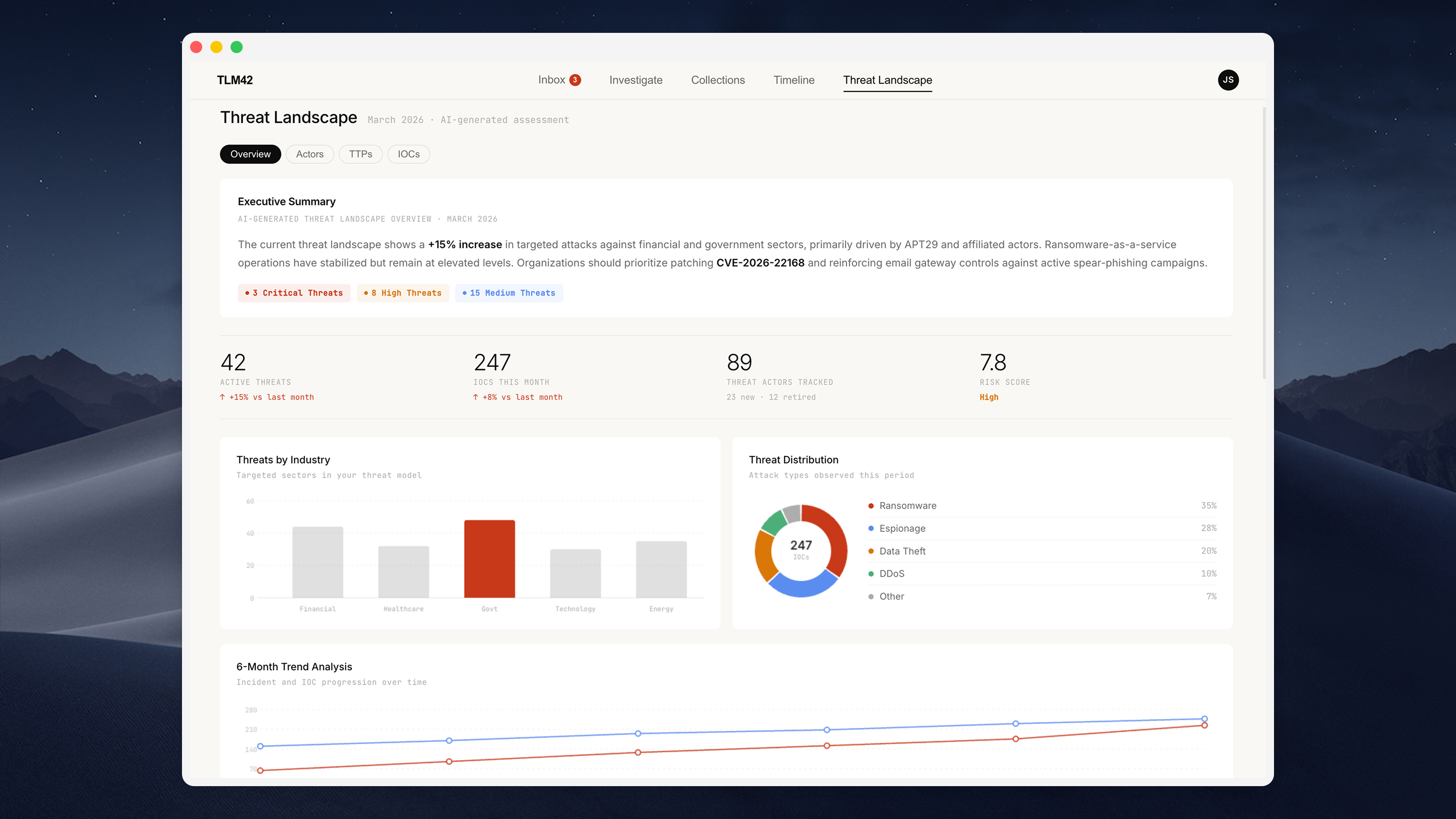
TLM42 · investigation workspace
TLM42 · evidence canvas & AI reasoning
Iteration V3 · light-mode exploration of the investigation entry
Iteration V3 · light-mode exploration
Iteration V4 · intelligence inbox with priority intelligence requirements
Iteration V4 · intelligence inbox & PIRs

Outcomes & Impact

10
Design iterations from concept to demo-ready
5
User personas researched across all major SOC roles
4 wks
Concept through RSA-ready demo delivery
V10
Live prototype: clean, minimal, investigation-first
"Designing in code, using AI to close the distance between what you imagine and what you can test, changes what's possible in the design process."
Previous Project
MindSync Brand Intelligence
Next Project
Engyon Audit Platform